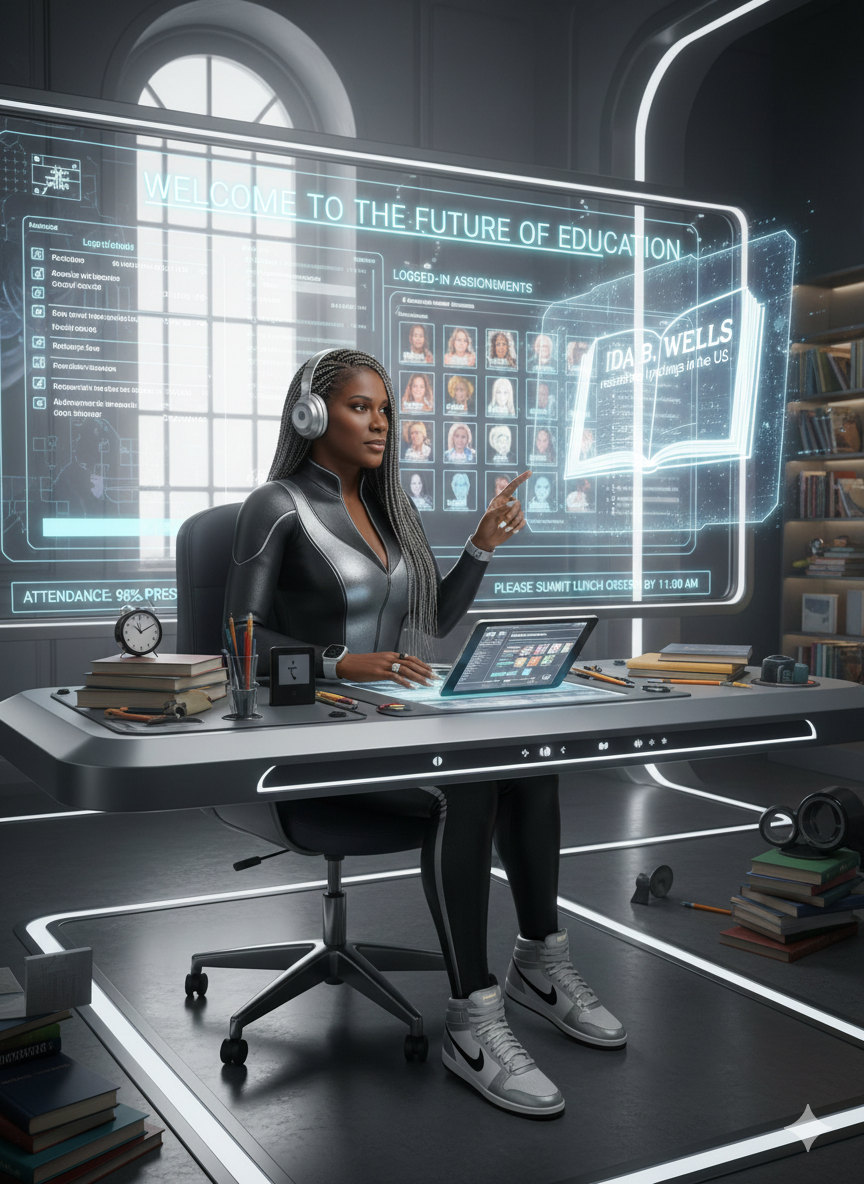
Artificial Intelligence has officially entered the classroom—not as a passing trend, but as a transformative force reshaping how educators plan, teach, assess, and reflect. For teachers across the country, the integration of AI into professional practice is met with a complex blend of enthusiasm and caution. It is viewed simultaneously as a capacity-building tool and a potential disruptor of authentic learning.
At B. Antoinette Designs, we believe this tension is not only natural—it is necessary. It signals that educators are engaging critically with technology rather than adopting it unexamined. The real question is not whether AI belongs in education, but how it can be used responsibly, ethically, and humanely.
The Case for AI: Capacity Building, Creativity, and Care
For many educators, AI has emerged as a powerful ally in an increasingly demanding profession. When implemented thoughtfully, it offers meaningful opportunities to reclaim time, expand creativity, and better serve diverse learners.
Reclaiming Time for What Matters Most
Teachers consistently report that AI-driven tools can save up to six weeks per academic year by automating routine administrative tasks such as grading, data entry, scheduling, and documentation. This recovered time is not trivial. It translates directly into increased capacity for student conferencing, relationship-building, instructional refinement, and—critically—educator wellness.
In a profession marked by burnout and attrition, AI’s greatest contribution may be its ability to give teachers back the one resource they never have enough of: time.
A Catalyst for Creative Instruction
Contrary to popular narratives, the most common use of generative AI among teachers is not shortcutting instruction, but creative brainstorming. Educators are using AI to generate lesson ideas, discussion prompts, simulations, writing exemplars, and interdisciplinary connections. Rather than replacing professional expertise, AI often functions as a collaborative thought partner—one that helps teachers expand what is possible in their classrooms.
Personalization and Accessibility
AI also shows strong promise in supporting differentiated instruction. By identifying learning patterns and providing real-time feedback, AI-assisted tools help teachers tailor instruction to meet individual student needs. For students with disabilities, English language learners, and those requiring alternative modes of access, features such as speech-to-text, text-to-speech, and real-time translation are not conveniences—they are gateways to equity.
A Support System for Early-Career Teachers
For teachers in their first five years, AI can serve as an invaluable scaffold. From lesson planning to assessment design, AI tools help reduce the steep learning curve of the profession while reinforcing best practices. When used appropriately, AI does not diminish professional growth—it accelerates it.
The Concerns: Learning, Integrity, and Human Connection
Despite these advantages, skepticism remains—and rightly so. Many educators are deeply concerned about the long-term implications of AI on learning and teaching.
The Erosion of Critical Thinking
Approximately 70% of teachers express concern that AI may weaken students’ critical thinking, research, and problem-solving skills. When answers are instant and frictionless, the cognitive struggle that underpins deep learning risks being bypassed. Teachers worry that students may rely on AI to do the thinking for them, rather than engaging in inquiry, synthesis, and analysis.
Academic Integrity and the “Cheating Crisis”
AI-assisted plagiarism has created what many educators describe as an instructional “arms race.” Teachers now expend significant time verifying originality, redesigning assessments, and policing misuse—time that could otherwise be spent teaching. The challenge is not merely technological; it is philosophical. It forces schools to reconsider what authentic learning and assessment should look like in an AI-saturated world.
The Fear of Dehumanized Learning
Perhaps the most profound concern is the potential loss of human connection. Data suggests that nearly half of students report feeling less connected to their teachers when AI tools are heavily integrated. Educators worry that overreliance on technology may stunt students’ social-emotional development and reduce learning to a transactional exchange rather than a relational experience.
Surveillance, Bias, and Privacy
Finally, teachers are increasingly wary of AI as a tool of surveillance. Concerns about algorithmic bias, data privacy, and the use of AI to monitor classroom performance are not unfounded. Without transparency and safeguards, AI risks reinforcing inequities rather than dismantling them.
The Real Issue: The Training and Policy Gap
A significant portion of teacher resistance does not stem from AI itself, but from the lack of guidance surrounding it. While an estimated 85% of teachers used AI during the 2024–2025 school year, fewer than half received formal training from their districts. Many educators are left navigating complex tools independently while also being tasked with monitoring bias, misinformation, and misuse.
This “AI vacuum” creates frustration, fear, and inconsistency—and underscores the urgent need for professional learning that is ethical, practical, and grounded in pedagogy.
A Way Forward: Human in the Loop
Educational leaders increasingly advocate for a “Human in the Loop” approach. In this model, AI functions as a complementary enhancement, not a replacement for professional judgment. Much like an electric bike amplifies human effort without removing the need to pedal, AI should extend—not replace—the intellectual, emotional, and ethical work of teaching.
At B. Antoinette Designs, we believe the future of education lies in intentional integration. AI should support educators in thinking deeper, teaching better, and caring more—not in outsourcing the very humanity that defines the profession.
The goal is not smarter machines.
The goal is empowered educators and liberated learners.
And that future is still very much in human hands.